What Is True Luxury?
From Premium to Elite Luxury
The word Luxury is now applied to clothing, cars, watches, furniture, and ordinary goods. Yet a high price or prestigious label alone does not define luxury.
Premium vs. Luxury
Premium generally means superior quality, performance, materials, and features compared with standard products. Luxury adds other dimensions: rarity, distinctive aesthetics, symbolic meaning, and extraordinary qualities that go beyond practical utility.
A Premium product can be exceptionally well-made without being rare. A Luxury object is not defined by better functionality or a higher price alone; what makes it exceptional must also be considered.
To answer these questions, we need to understand the different levels of luxury and what distinguishes them from one another.
Four Levels of Luxury: From Entry-Level to Elite
Research into luxury brands includes a classification that divides them into four levels. Below, they are presented in descending order of exclusivity — from the highest to the lowest.
In general, the higher the level, the greater the importance of rarity, exceptional qualities, craftsmanship, and the cost of products. However, this is not an absolute price scale: individual products from different categories may overlap in price.
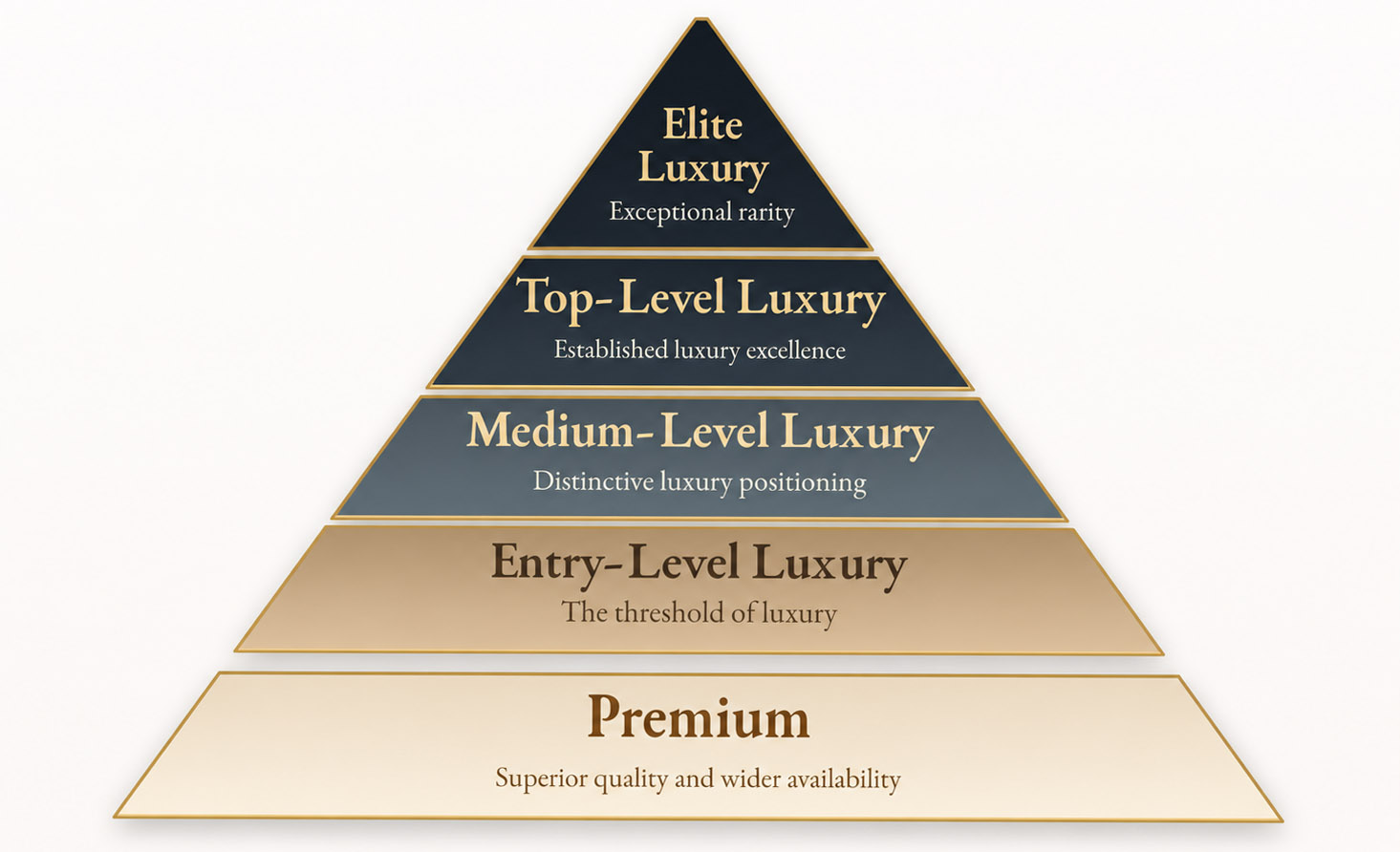
1. Elite-Level Luxury
The highest category of luxury.
Elite Luxury is characterized by exceptional craftsmanship, rarity, artistic value, and maximum exclusivity.
Unlike global mass production, individual commissions, one-of-a-kind creations, and limited editions occupy a particularly important place here.
This segment may include small independent and family-owned businesses that preserve unique artisanal traditions across generations.
Connoisseur Brands — Luxury for Those Who Know
Unlike globally recognized Star Brands, Connoisseur Brands are often known mainly within a narrow circle of knowledgeable customers. Their reputation grows through specialist expertise, personal recommendations, exceptional craftsmanship, and the appreciation of collectors.
Limited production capacity, rare materials, complexity of execution, and the individual nature of manufacturing can ensure the exclusivity of their products.
A limited audience does not mean a lower level of luxury. Exceptional quality and exclusivity matter more than public recognition.
Examples: Puiforcat — silverware; JAR — jewelry art; Greubel Forsey — watchmaking.
2. Top-Level Luxury
Top-Level Luxury is distinguished by highly developed product and brand characteristics, an established reputation, and strong symbolic value. Worldwide fame is not a requirement.
Their products are associated with prestige, status, and belonging to a particular cultural world.
Some representatives operate internationally and offer serial collections, while others work on a smaller scale. The volume of business alone does not determine the level of luxury.
At the same time, they may also create individually commissioned and exceptionally rare pieces.
Top-Level Luxury is not defined by global recognition or business size. Its position depends on the qualities of the products and the brand.
Examples from the research classification: Armani, Cartier, Louis Vuitton.
3. Medium-Level Luxury
These are established luxury brands that possess the characteristic features of Luxury but rank below the leading representatives of the segment.
They offer a combination of quality, aesthetics, recognizable style, prestigious positioning, and symbolic value.
A significant proportion of their products are mass-produced and intended for international markets.
Compared with Elite Luxury, such products are generally more accessible and less restricted in their distribution.
Examples from the research classification: Dolce & Gabbana, Escada, Moschino.
4. Entry-Level Luxury
This is the lowest category of Luxury, directly bordering on Premium.
It includes certain characteristics of luxury: brand recognition, prestigious positioning, aesthetics, and symbolic value.
However, products are generally more accessible, widely distributed, and predominantly mass-produced.
The boundary between Entry-Level Luxury and Premium can be relatively blurred.
Examples from the research classification: Hugo Boss, Mercedes-Benz.
The brands mentioned are examples from a research classification, not current official rankings. Different product lines within the same brand can occupy different luxury levels.
Luxury, Recognition and Business Scale
The level of luxury, brand awareness, and business volume are three separate dimensions. A highly exclusive manufacturer may be little known beyond collectors and connoisseurs, and a globally famous brand with substantial sales is not necessarily in the highest luxury segment. Evaluate the qualities and exclusivity of the products separately from the popularity and commercial size of the business.
Mass Production and Exclusivity
One of the significant differences between luxury levels lies in the scale of production and product availability.
Production scale and product exclusivity are related but not identical. Large brands may create unique commissions, while small houses can produce recurring collections.
One-of-a-kind pieces. Individually commissioned or unique objects cannot be purchased as identical repeat editions.
Limited editions. A restricted number of pieces offers greater scarcity than an ongoing collection, although edition size and genuine differences matter.
Wider collections. Serially produced objects can retain fine craftsmanship and luxury qualities, but are generally more accessible. Production quantity alone does not establish the level of luxury.
This is why small private and family-owned companies can occupy a special place in the highest luxury segment.
Their value may lie not in the number of stores, advertising campaigns, or global recognition, but in their ability to create rare and exceptional objects.
However, family ownership alone does not guarantee exclusivity, just as the global scale of a business does not prevent it from creating unique works.
Iconic Brands and Cult Brands: Recognition Is Not the Same as Exclusivity
In addition to the classification based on luxury levels, there is another system based on the symbolic value of brands.
Two categories are of particular interest: Iconic Brands and Cult Brands.
Iconic Brands
Iconic brands transcend their products and become widely recognized cultural symbols.
They are associated with universal values such as success, status, freedom, prestige, or a particular lifestyle.
Examples: Rolex, Chanel, Coca-Cola.
These brands enjoy widespread recognition and can appeal to a large audience.
However, iconic status does not necessarily imply belonging to the highest level of Luxury. A brand can become a cultural symbol even outside the luxury market.
Cult Brands
Cult brands build relationships with a narrower but exceptionally loyal audience.
Their customers share particular values, philosophies, and perceptions of the product.
Unlike widely recognized iconic brands, cult brands may remain relatively unknown outside their communities.
However, their value lies not only in emotional connection, history, or belonging to a particular circle.
A true cult brand also offers genuine product value — its quality, functionality, distinctive execution, and other tangible advantages.
Examples of Cult Brands include Harley-Davidson, Leica, and Pagani.
It is important to understand that Iconic and Cult are not additional levels of Luxury. They describe the nature of a brand's relationship with consumers and can exist across different price categories.
Thus, a brand may be globally recognized without belonging to Elite Luxury. Conversely, exceptionally rare and expensive products may be created by a manufacturer that is virtually unknown to the general public.
What Defines True Luxury?
In his study, Klaus Heine identifies six central characteristics of luxury products. They are distinct from, but often supported by, craftsmanship and heritage.
-
Price. A high price may signal exclusivity, but cannot prove it on its own.
-
Quality. Exceptional materials, meticulous execution, and enduring performance.
-
Aesthetics. Distinctive design, beauty, artistic expression, and sensory appeal.
-
Rarity. Restricted availability of products, materials, or expertise.
-
Extraordinariness. Originality and unusual qualities that go beyond the ordinary.
-
Symbolism. Meaning, identity, and significance beyond practical function.
No single characteristic guarantees the highest level of luxury. Craftsmanship and heritage may strengthen quality, extraordinariness, and symbolic meaning, but are not separate items in Heine's six-part list.
Luxury Products and Luxury Brands Are Not the Same
An exceptional luxury object need not come from a globally famous brand. Likewise, a prestigious house may offer products at several levels of exclusivity. Judge the qualities of an individual object separately from the recognition and reputation of its manufacturer.
Why Can Two Objects Serving the Same Purpose Have Completely Different Prices?
Imagine two products that perform exactly the same function.
The first is mass-produced using standard materials and industrial technologies. It may be well-made, reliable, and fully suited to its intended purpose.
The second is individually created using rare materials, intricate handwork, and unique artistic solutions. Its production may require specialized expertise and considerable time.
From a practical standpoint, both objects may perform the same task.
But their value is formed in fundamentally different ways.
In the first case, the buyer primarily pays for functionality, materials, and quality.
In the second, the price also reflects rarity, exceptional craftsmanship, individuality, and artistic and symbolic value.
This is why the same purpose does not mean the same price or the same level of luxury.
However, a high price alone does not prove that an object is exceptional. It is necessary to understand which genuine qualities justify that price.
True Luxury Is More Than a High Price and a Famous Name
Today's market offers an enormous number of products described as Luxury. But belonging to the world of luxury is not determined by an advertising label.
As we move from Entry-Level to Elite Luxury, cost, rarity, complexity of execution, and exclusivity generally increase.
At the same time, a manufacturer's global recognition does not always reflect the exceptional nature of an individual product.
A major international brand can create outstanding works. A small independent workshop can also produce objects of the highest standard while remaining virtually unknown to the mass market.
True luxury depends on exceptional product qualities, not simply on how widely a brand name is recognized.
Research reference: Klaus Heine, The Concept of Luxury Brands, 2nd ed. (2012), especially pp. 62-67. Classification and concepts are discussed in this article in independent wording.